Motte and Bailey Castle Sites: How to Spot One and What Survives
What a motte and bailey castle was, how to spot the mound and bailey in a field or on a map, and why most Norman earthwork sites have no stone left.
A motte and bailey castle is a Norman castle built from earth and timber: a raised mound called the motte, topped by a tower, with a fenced enclosure called the bailey beside it. Timber rots, so most of these castles survive as a steep grassy mound and a flat platform in a field, with no stone at all.
That is why clicking a castle on a map and arriving at a lumpy green field happens so often. Thousands of earthwork castles went up after 1066, and only a minority were ever rebuilt in stone. For the background on what castles were for in the first place, start with that guide. This page is about reading the ground once you get there.
Who built motte and bailey castles, and why
The Normans. After the conquest of England in 1066, a small ruling group had to hold a large and unfriendly country, and earth and timber was the quickest way to do it. Local labour could raise a mound and a palisade in weeks. Stone needs years, money and skilled masons.
The method travelled. Marcher lords pushed it along the Welsh border. Anglo-Norman lords carried it into Ireland in the late twelfth century, which is why counties like Louth, Meath and Wexford have so many mottes. Scottish kings granted land to Norman and Flemish families, who built the same way, so mottes turn up in Dumfries and Galloway and Ayrshire too.
The design was not invented in England. Motte and bailey castles were already being built across Normandy and northern France before the conquest.
How do you spot a motte in a field?
Look for several of these signs together, not just one:
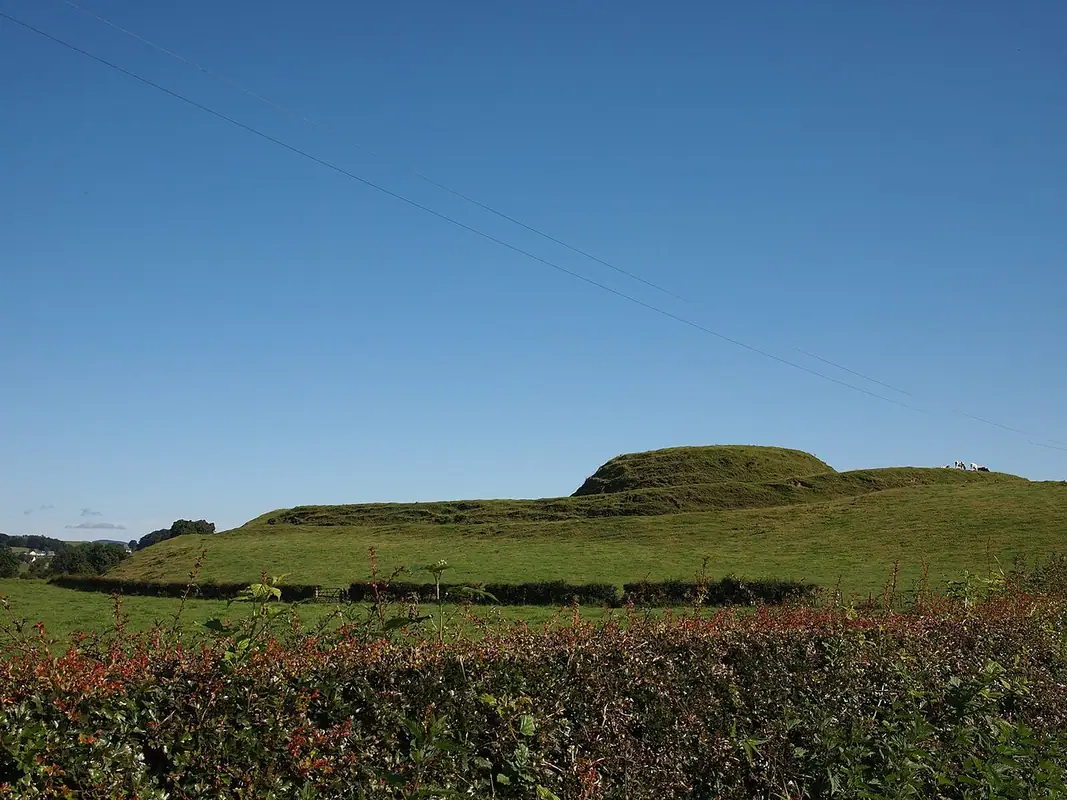
- A steep, roughly round mound that is flat on top rather than pointed.
- A ditch around the base, often silted down to a shallow dip.
- A level area next to the mound, edged by a low bank. That is the bailey.
- A river crossing, road junction or valley route in view. Castles watched something.
- A church or old village core right beside it.
- Rabbit scrapes showing soil and rubble instead of solid rock.
The ditch and the mound are the same piece of work. Diggers cut a ring and piled the spoil in the middle, so a motte is usually surrounded by its own quarry. Where the ditch held water you get a wet moat, and in flat country that was the normal result rather than a luxury.
What does a motte look like on a map?
Start with the name. Castle Hill, Castle Mound, Mount, Tump, Toot, Mote and Moat all flag earthwork castles on Ordnance Survey maps. Motte appears plainly in Irish names such as Granard Motte and Dun Dealgan Motte.
On the map face, look for a tight knot of contour rings on otherwise even ground, a small hachured mound symbol, or the words Castle (site of) in the antiquity typeface. Tumulus means a burial mound, so treat that one as a different animal.
Satellite imagery helps if the sun is low, because the mound and ditch throw shadows that are invisible at midday. In England you can also check whether a site is a scheduled monument on the National Heritage List.
From timber to stone: rebuilt, abandoned or ploughed out
Earthwork castles went three ways.
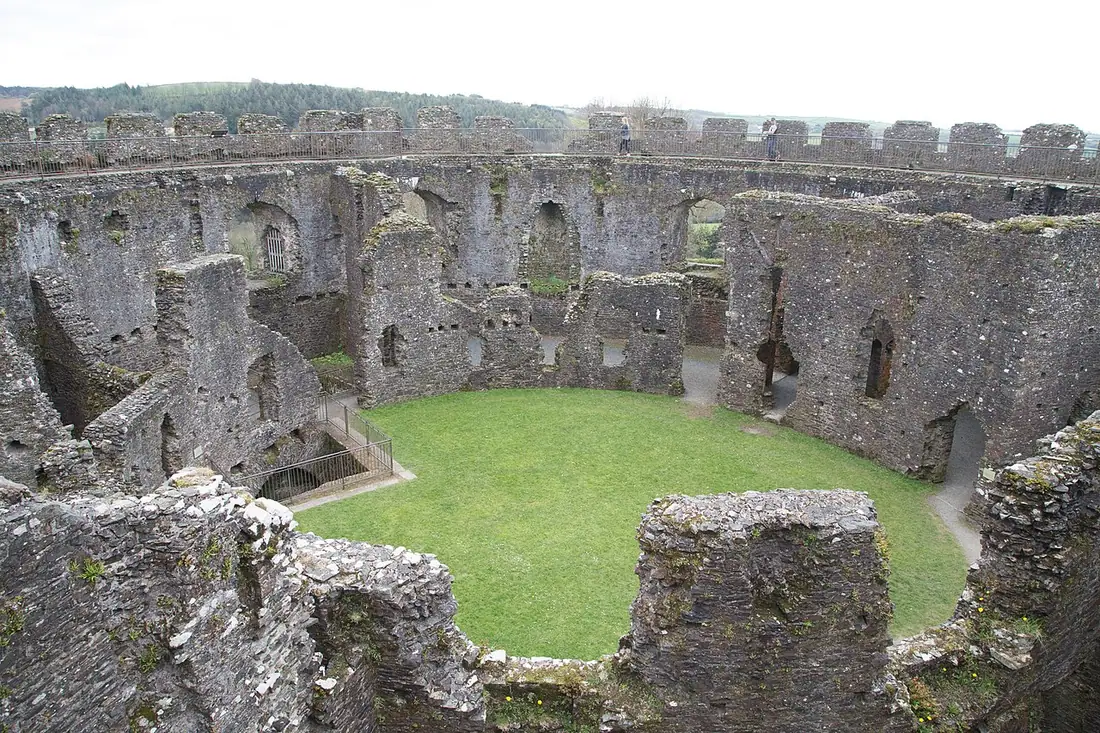
Some were rebuilt in stone. A stone tower could be set on the mound itself, as at Windsor, or the mound’s rim could be ringed with a wall to make a shell keep, as at Restormel and Launceston in Cornwall. Cardiff shows the same move on a far bigger motte. The timeline of castle building follows that shift from timber to masonry.
Most were simply dropped. A castle raised during one campaign had no job once the fighting moved on, and the lordship it served might last a generation.
The rest were flattened. Ploughing, quarrying, railway cuttings and housing have all taken mottes, and in many towns the mound is now a park feature or a bump under a car park.
Motte and bailey, shell keep or concentric castle?
| Type | What you see today | Example |
|---|---|---|
| Motte and bailey | Grass mound, ditch, flat enclosure, no masonry | Motte of Urr, Dumfries and Galloway |
| Shell keep | Ring of wall around the top of a mound, open yard inside | Restormel, Cornwall |
| Stone keep | One tall thick walled tower | Rochester, Kent |
| Concentric | Two rings of wall, outer lower than inner, strong gatehouses | Beaumaris, Anglesey |
Concentric castles are the opposite end of the story. They came late, cost enormous sums, and put their strength in layered walls rather than a mound. The four main castle types and how to tell them apart sets them side by side. Further north and west the local answer was different again: the tall, narrow tower house that Scotland and Ireland are full of.
Norman earthwork castles worth visiting
- Motte of Urr in Dumfries and Galloway, one of the largest and clearest earthwork castles in Scotland.
- Hen Domen in Powys, a much studied timber castle site near Montgomery.
- Pleshey in Essex, where the mound, moat and bailey still shape the village plan.
- Berkhamsted in Hertfordshire, with wide water filled ditches you can walk around.
- Thetford in Norfolk, a huge mound reusing an earlier enclosure.
- Skipsea in the East Riding of Yorkshire, set beside what was once a mere.
- Tomen y Rhodwydd in Denbighshire, a crisp, well kept Welsh example.
Some sit in state care with open access. Others are on working farms, so ask before crossing a field.
Why do so many motte sites have no stone left?
Because there was never any stone to begin with. The tower, the palisade, the gate and the bridge were all wood, and wood that is not maintained is gone within a century or two.
Stone robbing finished the job on the sites that did get masonry. A ruined wall was free building material for barns, field walls and houses nearby.
So the mound is the monument. It also explains why counts of castles run high while the number of impressive ruins is much smaller, a gap covered in the guide to how many castles there are in the UK.
Where to go next
To find the earthwork castles near you, open the map of castles across the UK and Ireland and zoom into your county. Mottes, ringworks and bare mounds are listed there alongside the big stone names, so you will know whether you are heading for a gatehouse or a grass cone before you set off.
Questions
How tall is a motte?
It varies a lot. Many stand roughly three to ten metres above the ground around them, and a few of the big ones rise far higher than that. Height depended on the labour available and the job the castle had to do. A low mound in a field can still be a genuine motte, so judge it by the ditch and the bailey beside it rather than by size alone.
What is the difference between a motte and a ringwork?
A motte is a raised mound with a tower on top. A ringwork has no mound. Instead the defenders dug a circular ditch and threw up a bank around a level enclosure, then set a palisade on the bank. Both are Norman earthwork castles, both were timber built, and both can have a bailey attached. Ringworks are simply the flat version.
Is every grassy mound in a field an old castle?
No. Prehistoric burial mounds, windmill mounds, spoil heaps and natural hillocks all get mistaken for mottes. Burial mounds are usually lower, rounder and dome shaped, with no ditch and no flat enclosure beside them. Irish ringforts are a different thing again. The giveaway for a castle is the combination of steep sides, a flat top and an attached bailey.
Can you climb a motte?
Often yes, but check who owns it. Many mounds sit on private farmland, and plenty are legally protected monuments where digging or metal detecting is an offence. Climbing wears paths into soft earth, so stick to any marked route. Where a motte is in public care or has a footpath across it, the top is usually the best viewpoint for miles.
Why is it called a bailey?
The word reaches English through Old French, where it meant an enclosure or courtyard. The bailey was the working part of the castle: hall, kitchen, stables, stores and workshops, all inside a bank, ditch and timber fence. The motte held the lord's tower and the last line of defence. Some castles had two baileys, one on either side of the mound.