Castles with Turrets: Scottish Baronial Spires and Where to See Them
Castles with turrets are mostly Scottish Baronial, not medieval. See which castles have the pointed spires, where to find them, and how to photograph them.
Castles with turrets are mostly Scottish, and most of those turrets are decoration rather than defence. The pointed corner towers people picture when they picture a castle come from a style called Scottish Baronial, and the clearest places to see them are Craigievar, Fyvie and Glamis in the northeast of Scotland, Dunrobin on the Sutherland coast, and Castell Coch north of Cardiff.
The distinction matters. A fighting tower and a turret are not the same thing, and if you want the short version of why castles went up in the first place, that guide covers the real job. Most of the famous turreted silhouettes came later, once the fighting had stopped and the owner wanted the look.
Turret, tower or spire: what is the difference?
A turret is a small tower that sticks out from a wall or corner and usually starts partway up the building, carried on stone brackets. A tower rises from the ground and holds rooms. A spire is the pointed roof on top, not the structure underneath it.
| Part | What it is | How to spot it |
|---|---|---|
| Tower | Full height structure with floors inside | Starts at ground level, with a door or windows low down |
| Turret | Small tower hung on the wall above | Begins halfway up, often on a corner, sits on stone brackets |
| Bartizan | The Scottish word for a corner turret | Round, cantilevered, up at the wall head |
| Spire or cone | The pointed roof itself | Slate or lead cap, often called a candle snuffer roof |
Corbelling is the giveaway. Those stepped brackets under a Scottish turret carry its weight out over thin air, and they are the signature of the sixteenth and seventeenth century tower house. If the stonework steps outward before the turret starts, you are looking at baronial work rather than Norman.
Scottish Baronial castles with turrets
Craigievar Castle in Aberdeenshire is the one to see first. The lower walls are plain pink harling with few windows, then the top two floors break out into turrets, gables and cones, like a plain tower wearing a crown.
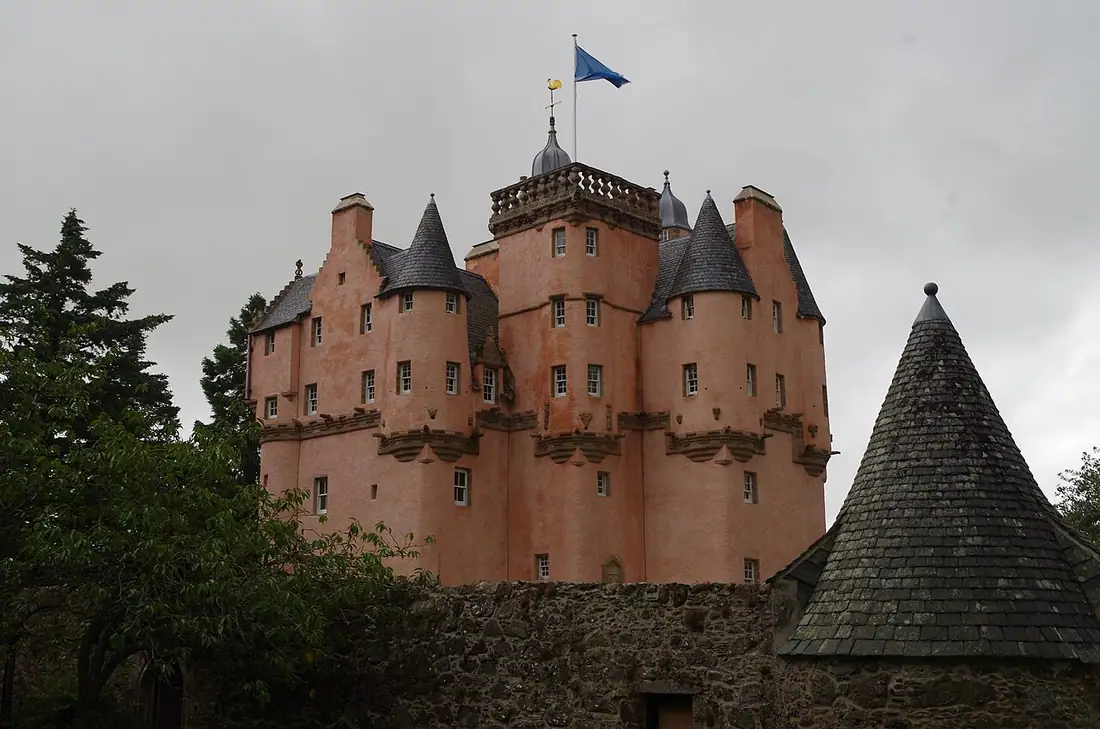
Fyvie Castle, also in Aberdeenshire, does the same thing at palace scale across a long front, with turret after turret along the wall head and a great wheel stair inside.
Glamis Castle in Angus is the grandest version, pink sandstone with a tall central block and spires going up in every direction. It is the castle most people have in mind when they say fairytale.
Three more in the same country: Crathes and Castle Fraser in Aberdeenshire, and Claypotts near Dundee, where the round corner towers are capped with square chambers that look wrong in a photograph until you see them in person. Claypotts is cared for by Historic Environment Scotland.
The northeast has an unusual number of these, and the reasons sit in why Scotland ended up with so many castles.
Why Victorian owners added turrets that defended nothing
The Scottish Baronial style began as real tower house building and came back as a revival. Nineteenth century owners liked the look, copied the turrets, crow stepped gables and conical roofs onto new houses, and left out everything that made the old ones defensible.
Walter Scott’s house at Abbotsford in the Borders helped set the fashion. Balmoral on Deeside made it royal. After that, every laird with money wanted a wall head that bristled.
Dunrobin Castle in Sutherland is the full version, a Victorian remodelling of spires and conical caps that owes more to French chateaux than to Scottish warfare. It is a house in castle dress, which is where the line between castle, palace and grand country house starts to blur.
The tell is comfort. Large evenly spaced windows, neat identical stonework, turrets with no sight line along any wall they could cover.
Castles with towers you can actually climb
If you want stairs rather than silhouettes, head for the Welsh and English castles whose towers are open to visitors.
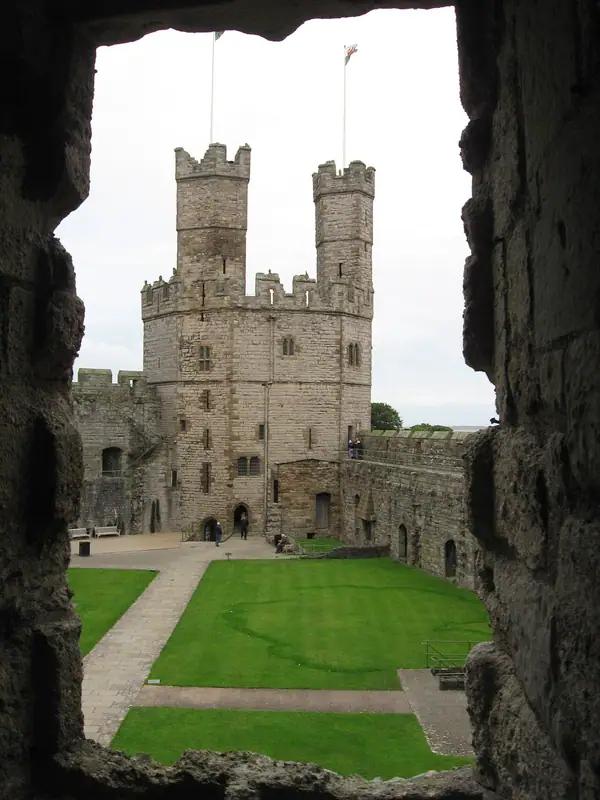
- Caernarfon in Gwynedd, where the Eagle Tower carries three stone turrets at the top.
- Conwy, with eight towers and a wall walk running right round the town.
- Warwick, where Guy’s Tower and Caesar’s Tower both go up.
- Clifford’s Tower in York, plus the towers at Lincoln and Dover.
Those are the main castle layouts in working form, and the types of castles and how to tell them apart sorts out which is which. Check opening times before you travel, because tower access shuts in high wind more often than the castle itself does.
Castles with arches, and what they are telling you
Arches date a building faster than almost anything else. A round headed arch over a door or window usually means Norman work. A pointed arch means Gothic, so later. The castle building timeline puts the two in order.
Look for the barrel vault over a tower house basement, the arched pend through a gatehouse, and the slot where a portcullis once ran. In baronial houses the arches are mostly for show, carved over a doorway with the family arms set above.
The fairytale castle look, and the German castles people credit for it
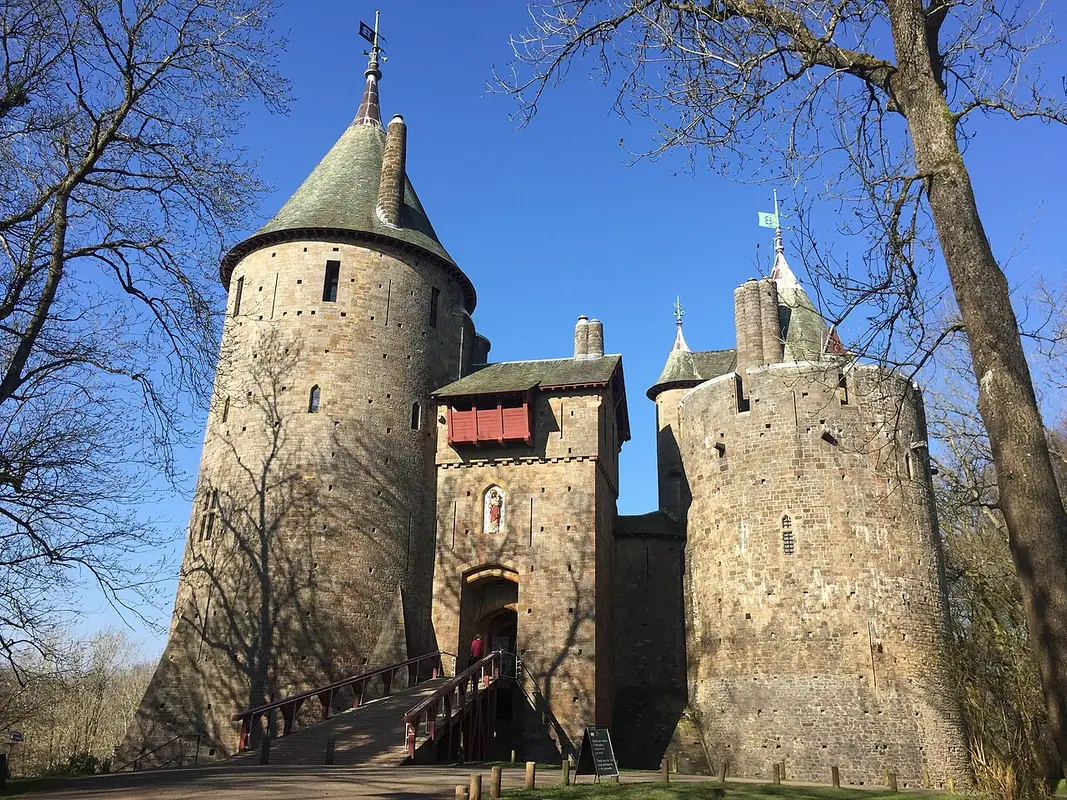
Fairytale castle is a shape, not a type: tall walls, slim round towers, pointed spires. In Britain and Ireland the best of it is Victorian. Castell Coch near Cardiff, built for the Marquess of Bute to William Burges’s designs, is a hillside of conical roofs over genuine medieval footings. Ashford Castle in County Galway is the Irish equivalent, a Guinness family rebuild that runs as a hotel today.
People often assume the look was copied from Bavaria. Neuschwanstein comes from the same century and the same romantic mood, not from an earlier source. Both borrowed from the French chateaux of the Loire, which is where the slim tower with a cone on top really starts.
Best light and angles for photographing a turreted castle
- Shoot in low side light, early or late. Corbels and cones need shadow to read, and flat midday light erases them.
- Get close and point up to stack the turrets against the sky. From a distance they shrink into the roofline.
- Or do the opposite. A long lens from across a field squeezes the turrets into one cluster.
- Harled walls like Craigievar’s turn warm at golden hour. Grey granite does not, so give granite a dramatic sky instead.
- After rain, slate cones go dark and glossy and separate from the stone below.
- Walk the whole way round before you shoot. One side nearly always has more turrets than the rest.
Where to go next
Pick a castle, then plan the drive. The site’s map and index of all castles across the UK and Ireland lists every entry by nation and county, so you can find the turreted ones near you and check which are open, ruined or private before you set off.
Questions
Is a turret the same as a bartizan?
Nearly. A bartizan is the Scottish name for a turret that sits on the corner of a wall and is carried on corbels, with no support running down to the ground. English writing tends to call the same thing a corner turret. If you see a small round tower that starts partway up a Scottish wall head, bartizan is the local word for it.
Can you go inside a castle turret?
Usually not. Many turrets are hollow stone caps with no floor inside, built to finish a roofline rather than to be used. The ones you can enter are the working sort, capping a stair or opening off a wall walk, and at places like Caernarfon and Conwy you climb into them as part of the route.
What are the pointed roofs on Scottish castles called?
Conical roofs, or candle snuffer roofs in everyday speech, because that is what they look like. They are usually slate or lead over a timber frame, sitting on a round corbelled turret. The shape is borrowed from French chateaux, which is why the whole silhouette reads as French to some eyes and Scottish to others.
Can you stay overnight in a castle with turrets?
Yes. A fair number of baronial houses and Irish castles run as hotels, Ashford Castle in County Galway among them, and plenty of smaller Scottish tower houses take guests. Check whether the turrets are original or Victorian if that matters to you, and whether your room is in the old block or a modern wing.
Which turreted castles are easiest to reach without a car?
Cardiff is the simplest. Cardiff Castle sits in the city centre a short walk from Cardiff Central station, and Castell Coch is a few miles north at Tongwynlais, reachable by local bus or a short taxi ride. The Aberdeenshire baronial castles are harder. Craigievar, Fyvie and Castle Fraser all sit in open country and really want a car.