Castles with Moats: Which Ones You Can Still Visit in Britain and Ireland
Which castles with moats still hold water, which moats are dry, and where drawbridge fittings survive. Visitor tips for England, Wales, Scotland and Ireland.
Castles with moats that still hold water are a short list, and most of the best are in southern England. Leeds Castle in Kent, Bodiam and Herstmonceux in East Sussex and Hever in Kent all sit in standing water you cross by bridge, and all four are open to visitors. Wales has Caerphilly, Scotland has Caerlaverock, and in Ireland water defence usually meant a river or a lake island rather than a dug ditch. For the wider picture, the guide to castles in the UK and Ireland covers every nation and county.
Which castles still have water in the moat?
A moat only stays wet where a spring, stream or high water table feeds it and someone keeps the banks and sluices in order. These are the clearest water-filled moats you can visit:
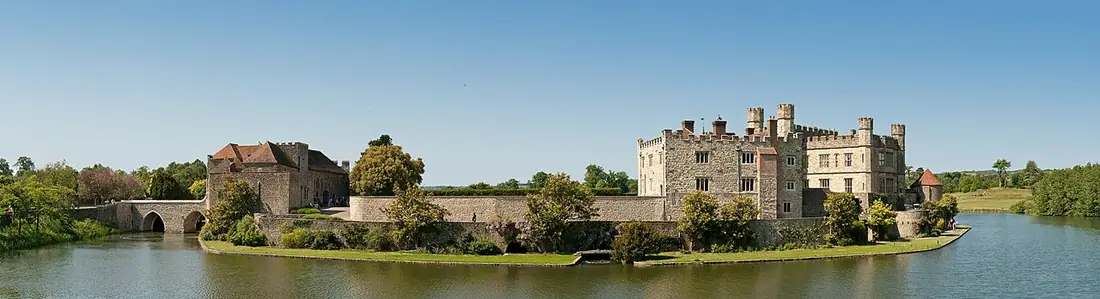
- Leeds Castle, Kent: two islands in a lake fed by the River Len.
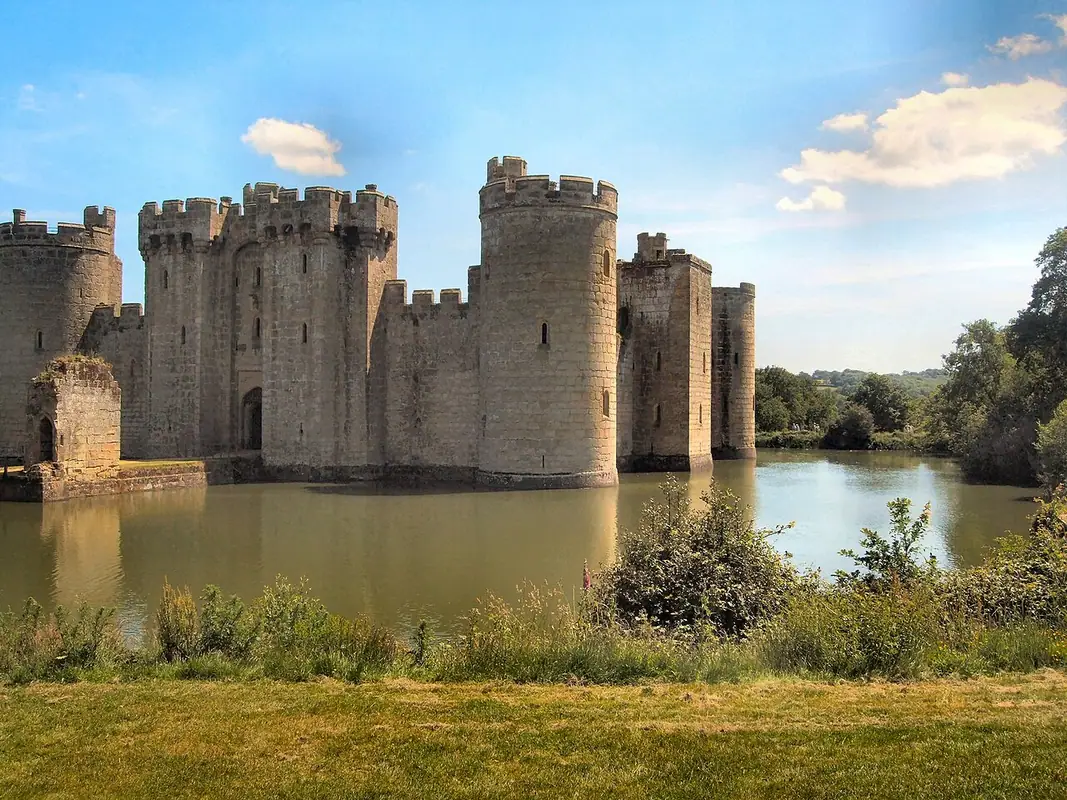
- Bodiam Castle, East Sussex: a square castle in a broad square moat.
- Hever Castle, Kent: a gatehouse and house ringed by water, with more water beyond.
- Herstmonceux Castle, East Sussex: brick walls rising straight out of the moat.
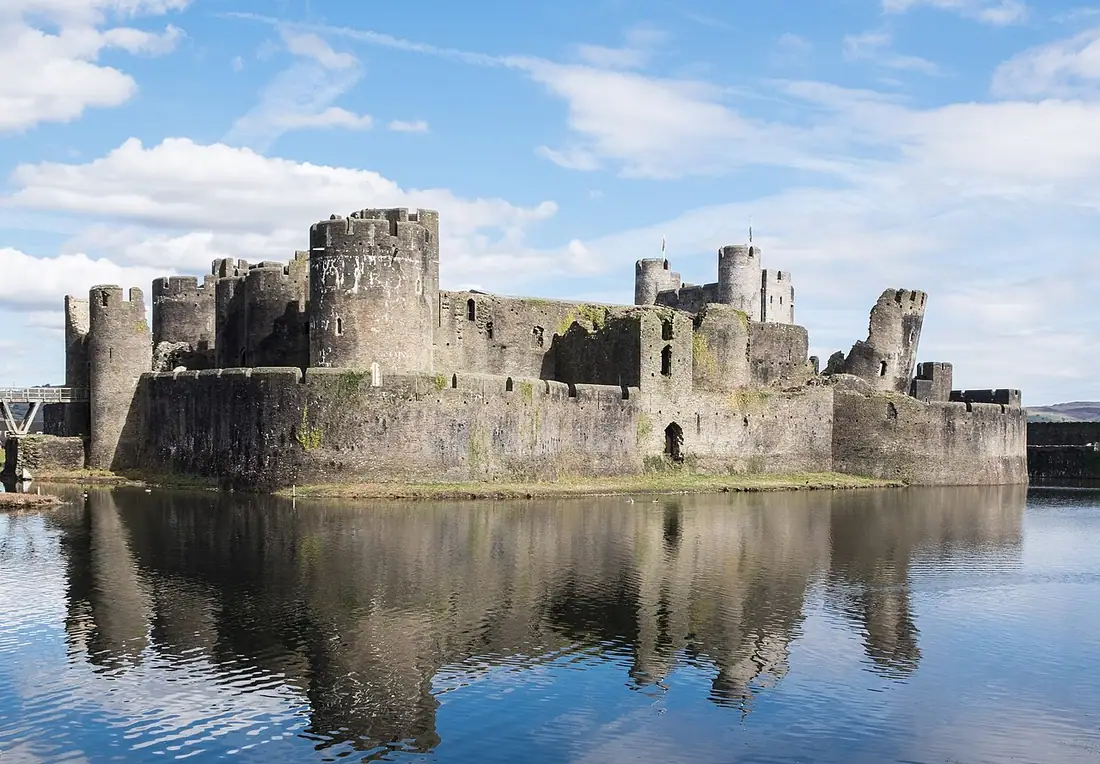
- Caerphilly Castle, south Wales: lakes and dams instead of a single ditch.
- Caerlaverock Castle, Dumfries and Galloway: a triangular castle inside a wet moat.
If you want the thinking behind all that digging, read why castles had moats and what was in them.
Leeds Castle, Bodiam and Hever: England’s classic moated castles
Leeds Castle is the one most people picture. The buildings stand on islands in a wide lake, so water is part of the view from almost every angle, and the walk around the park gives you the long reflection shot visitors come for.
Bodiam Castle is the neatest piece of design. Four round corner towers, a square plan, and a moat so regular it looks drawn with a ruler.
Much of that was display as well as defence. The approach once ran across the water at an angle, which forced anyone arriving to walk a long way in full view of the walls.
Hever’s moat is tighter and more domestic. The castle grew into a comfortable house behind its gatehouse, and the water now reads as a garden feature more than a barrier. Herstmonceux is the brick one, with walls that drop into the moat with no bank at all.
Smaller sites hold water too. Nunney in Somerset is a single tall block in a close-fitting moat, and you can walk right round it in about ten minutes.
Caerphilly and Caerlaverock: moats in Wales and Scotland
Caerphilly Castle has the most elaborate water defences in Britain. Rather than one ditch, it uses dams and artificial lakes to turn the whole site into a group of islands, with the approach funnelled along a walled platform. The scale is easier to read from the lakeside path than from inside the walls.
Scotland is the harder question. People search for castles in Scotland with a moat and come up almost empty, because Scottish builders usually had rock, sea or a loch to use instead.
Caerlaverock Castle near Dumfries is the great exception. It is a triangular red sandstone castle with a twin-towered gatehouse and a moat that still holds water, and the view from the car park side is the one to get.
Elsewhere in Scotland, look for the same problem solved another way: castles on loch islands, on tidal rocks, and on sea cliffs where the drop does the work. Ireland is similar, with tower houses set beside rivers and on lake islands. At Dublin Castle part of the medieval moat has been dug out and can be seen below ground level.
Dry moats and ditches: what to look for when the water has gone
Plenty of famous moats are dry, and some never held water. A moat cut into rock or free-draining chalk was a dry obstacle from the start, which is why so many hilltop castles have a deep ditch and no pond.
When the water has gone, the shape stays. Look for a ring of lower ground around the walls, a flat shelf between the wall base and the ditch, and a causeway that shows you where the gate stood.
Banks and ditches are often the only thing left at earthwork sites, which are one of the four main types of castle.
At Windsor the ditch beside the Round Tower is now a garden. At Old Sarum in Wiltshire the ditches are huge and bone dry. At Kenilworth the lake that once protected the walls was drained, so you walk over what used to be deep water.
Do any castles still have a working drawbridge?
Almost none. Timber bridges rotted or were replaced in stone, and where a lifting bridge exists today it is usually a reconstruction or a fixed bridge dressed to look the part. The winding gear hardly ever survives.
The evidence does survive. Above a gate arch, look for the two slots where the chains ran, the recess the bridge folded into, and the vertical grooves of a portcullis, which often did the real work of sealing a gateway. Cahir Castle in Tipperary keeps a portcullis in its gatehouse.
So a search for a castle with a moat and a drawbridge is really a search for a castle with a moat and a gate built for one. Bodiam, Caerphilly and Caerlaverock all show how the arrangement worked.
Visiting a moated castle: best views, boat trips and photo spots
The best view of a moated castle is from the far bank, not the courtyard. Walk the full circuit first if a path goes round, then go inside.
Still water early in the day gives the clean mirror image. Wind breaks it up by mid-morning, and low winter light does more for old stone than high summer sun.
Boat trips are normally on a nearby river or lake rather than the moat, since moats are shallow and fenced. Check opening times before you travel, because the grounds and the castle rooms often keep different hours and the water edge can close after heavy rain.
Where to go next
Pick your trip by distance. The Castles Near You pages list what is in reach of London, Edinburgh, Cardiff, Dublin and dozens of other starting points, so you can build a day around a moated castle and see what else is close. Start at castles near your nearest city.
Questions
Which castles with moats still have water in them?
Leeds Castle in Kent, Bodiam and Herstmonceux in East Sussex, and Hever in Kent all sit in standing water, and so does Nunney in Somerset. In Wales, Caerphilly keeps its lakes and dams. In Scotland, Caerlaverock near Dumfries has a wet moat around its triangular walls. All of them take visitors, though hours vary by season.
Are there castles in Scotland with a moat?
Very few. Scottish builders usually had rock, sea cliffs, lochs and tidal islands to work with instead of digging a ditch and filling it. Caerlaverock in Dumfries and Galloway is the clear exception, with water still standing in its moat. Elsewhere you find dry ditches around earthwork castles, and island castles that got the same protection from a loch.
Do any castles still have a working drawbridge?
Hardly any that work. Most timber drawbridges were replaced by fixed stone or modern bridges, and the winding gear almost never survives. What you can still see at many gatehouses is the slot where the chains ran, the pit the bridge dropped into, and the grooves for a portcullis, which was often the stronger half of the defence.
What is a dry moat?
A dry moat is a ditch with no water in it, either because it was cut into rock or free-draining ground and never held any, or because the supply was lost later. It still works by forcing attackers down a steep slope and up again in full view of the walls. Old Sarum in Wiltshire is a good one to walk.
Can you go out in a boat on a castle moat?
Usually not on the moat itself. Moats tend to be shallow, silty and fenced for safety, so boating is offered on a nearby lake or river where it is offered at all. Caerphilly's lakes and the park at Leeds Castle give you the water views without a boat. Check the castle's own visitor information first.